

America at 250: How Country Music Grew From the Nation’s Own Story
America’s story has always had a soundtrack.
Long before country music had charts, radio stations, recording contracts, stadium tours, award shows, and streaming playlists, it lived in the voices of everyday people. It lived in fiddle tunes on front porches, hymns in small churches, ballads carried across mountains, work songs in fields, cowboy songs on open range, blues rising from hardship, and family songs passed from one generation to the next.
As America marks 250 years, country music stands as one of the clearest reflections of the nation’s long, complicated, beautiful, and unfinished journey.
Country music did not come from one place or one people. It grew from many roots planted in American soil — immigrant traditions, African American musical influence, Appalachian ballads, gospel faith, rural storytelling, western frontier songs, southern blues, barn dances, honky-tonks, radio broadcasts, and the everyday lives of working people trying to make sense of love, loss, struggle, freedom, faith, and home.
That is why country music feels so American.
Not because it tells only one version of America, but because it carries so many of them at once.
The Sound of a Young Nation
In 1776, America was not yet the country we know today. It was a young nation trying to define itself, stitched together by colonies, farms, small towns, ports, churches, taverns, families, and hard-won ideas about independence.
Music was already part of that life.
People sang in churches. They played fiddle tunes at gatherings. They carried old songs from Ireland, Scotland, England, Germany, Africa, and other places into a new world. Those songs changed as the people changed. Lyrics shifted. Melodies bent. Instruments met new rhythms. Stories of kings and distant wars became stories of rivers, mountains, work, courtship, death, faith, and survival.
That is one of the most important things to understand about country music: it began as a people’s music.
It was not created in boardrooms. It was not polished for a market. It came from communities who needed songs for the lives they were actually living.
That foundation still matters today.
The Front Porch Was the First Stage
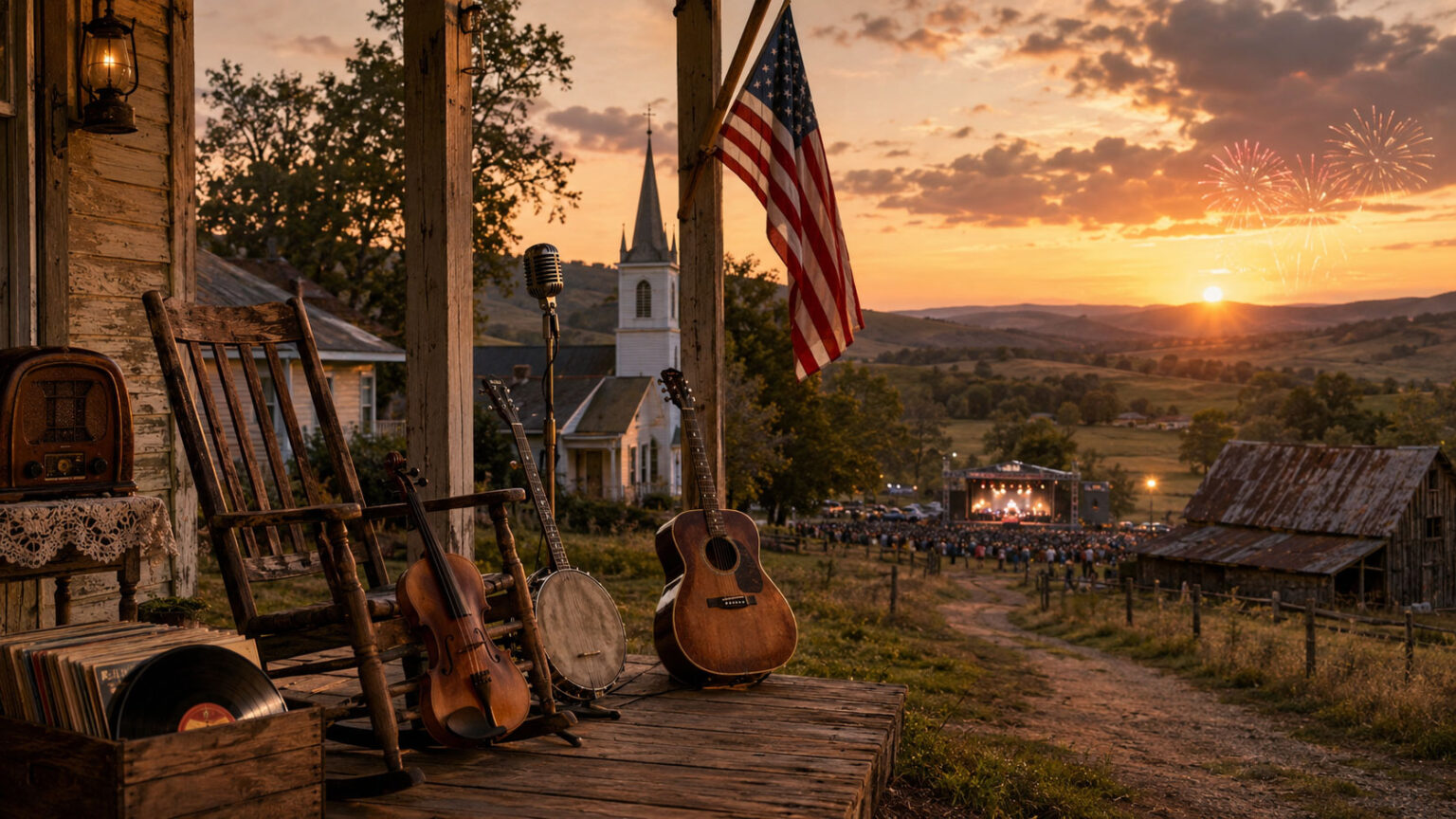
Before Nashville became Music City, before the Grand Ole Opry turned country music into a national broadcast tradition, the front porch was one of America’s first stages.
Families gathered there. Neighbors gathered there. A fiddle, a banjo, a guitar, or a mandolin could turn an ordinary evening into a memory. Songs were shared face to face, learned by ear, and carried across counties and states by people moving for work, land, opportunity, or survival.
The front porch mattered because it made music personal.
There was no distance between the singer and the listener. The song belonged to the room, the yard, the church, the barn, or the community. That closeness is still one of country music’s strongest traits. Even when country artists perform in stadiums, the best songs still feel like they are being sung directly to one person.
That intimacy is part of the American roots of the genre.
Country music was built for people who knew each other, worked together, worshiped together, danced together, mourned together, and needed songs that could carry real life.
Many Roots, One American Sound
Country music is often associated with the rural South and Appalachia, and for good reason. The mountains, farms, small towns, and working communities of those regions shaped the genre deeply. But country’s roots are broader than one region.
The banjo carries African origins. The fiddle brought European dance traditions into American life. Gospel gave country music its spiritual vocabulary. Blues gave it emotional depth, bent notes, and a way to sing pain without hiding from it. Cowboy songs carried the loneliness and freedom of the western frontier. Folk ballads preserved stories of tragedy, love, murder, migration, and memory.
Out of all those influences came something distinctly American.
Country music became a place where hardship and humor could sit side by side. A song could be about heartbreak, but still have a melody people wanted to sing together. A song could come from poverty, but still carry pride. A song could admit failure, but still believe in redemption.
That combination is America itself: imperfect, hopeful, restless, wounded, resilient, and always moving.
Radio Made the Music National
The rise of radio changed everything.
In the early 20th century, country music moved from porches, barns, churches, and local gatherings into homes across the country. Families could hear singers, string bands, comedians, gospel groups, and storytellers from far away. Regional sounds became national sounds.
The Grand Ole Opry, launched on WSM in Nashville in 1925, became one of the most important bridges between country music’s roots and its future. It gave artists a stage, gave fans a destination, and helped establish Nashville as the heart of country music.
Radio did not erase the front porch. It amplified it.
Suddenly, the sound of rural America could travel into cities, factories, farms, and living rooms. Country music became part of the national conversation because it spoke in plain language about things people understood: work, family, faith, drinking, dancing, love, death, home, and leaving home.
Country Music and the American Dream
Country music has always had a complicated relationship with the American Dream.
It celebrates the dream, but it also tells the truth about how hard it can be to reach.
For every song about a good time, there is a song about losing a job. For every anthem about freedom, there is a ballad about loneliness. For every song about home, there is one about having to leave it. That honesty is why the genre has lasted.
Country music understands that America is not only fireworks and flags. It is also long shifts, small paychecks, family farms, military service, factory towns, broken hearts, Sunday mornings, empty highways, and people trying again after life knocks them down.
At its best, country music does not pretend America is perfect.
It sings about the people who keep believing in it anyway.
From Honky-Tonks to Stadiums
Over the past century, country music has grown from regional roots into a global force.
It has lived through barn dances, western swing, bluegrass, honky-tonk, the Nashville Sound, outlaw country, country-rock, 1990s radio dominance, modern pop-country, Americana, red dirt, independent artist movements, and today’s streaming-driven explosion.
But even as the sound changes, the roots remain.
A great country song still needs a story. It still needs a feeling. It still needs enough truth for somebody to hear it and say, “That’s my life.”
That is why country music can evolve without losing itself. The instruments may change. The production may change. The platforms may change. But the emotional center remains close to the same: real people, real stories, real places, real consequences.
America’s Song Is Still Being Written
At 250 years, America is not only looking back. It is still becoming.
So is country music.
The genre’s future will include new voices, new regions, new influences, and new ways of telling old truths. That is not a threat to country music. That is how country music has always survived. It takes the lives people are living now and turns them into songs.
That has been true from the front porch to the radio tower, from the church pew to the honky-tonk, from the barn dance to the stadium stage.
Country music is one of America’s great cultural mirrors because it shows the country as it is: proud, painful, funny, faithful, divided, generous, restless, nostalgic, and still reaching for something better.
After 250 years, the American story is still not finished.
And somewhere, from a porch, a stage, a studio, a church, a truck cab, or a writer’s room, somebody is still turning that story into a country song.